
End impunity for crimes against journalists worldwide
Abuse, violence and killings of journalists require greater condemnation and urgent action, says NUJ.
UNESCO recognises “New technologies and weapons are changing the ways attacks against journalists are carried out. Yet one thing remains unchanged: those who kill are rarely held accountable.”
This year marks the 25th anniversary of the killing of Sunday World journalist Martin O’Hagan. For over two decades, the NUJ has been vocal in its calls for his perpetrators to be brought to justice. This year, Laura Davison, NUJ general secretary and Séamus Dooley, NUJ assistant general secretary have written to the Police ombudsman of Northern Ireland seeking a meeting and the release of a report into police-handling of O'Hagan's murder. Letters have also been sent to Naomi Long MLA, justice minister and Chris Bryant, secretary of state for Northern Ireland.
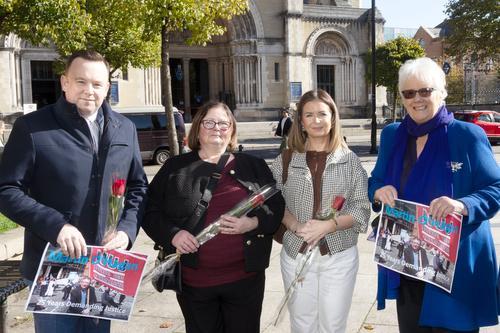
Fran McNulty, Tina and Niamh O'Hagan and Anne Hailes.
© Kevin Cooper
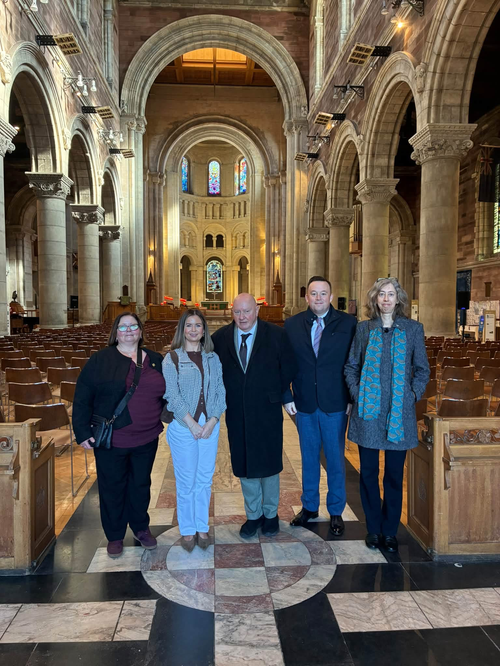
Tina and Niamh O'Hagan with Séamus Dooley, Laura Davison and Fran McNulty, NUJ president.
© Kevin Cooper
On International Day to End Impunity for Crimes against Journalists, the union mourns all journalists killed during the course of their work, including Lyra McKee killed in 2019 during riots in Derry. In July, the NUJ was represented at a Belfast crown court hearing as ‘not guilty’ verdicts were delivered in the trial of the NUJ member’s killing. Dooley speaking at the time, said "The NUJ had hoped that Lyra's family would find solace by securing a conviction through the judicial process.”
He stressed:
"It remains a matter of grave concern that no one was charged with the shooting of Lyra McKee; the person who pulled the trigger got off scot-free. In this case, someone has got away with the murder of a journalist - just as happened in the case of Martin O'Hagan.”
In 2022, NUJ member Dom Phillips was killed whilst undertaking research for his book. The murder of the journalist and indigenous expert Bruno Pereira in the Amazon rainforest revealed the shocking violence faced globally by journalists, including freelances.
Across the UK and Ireland, journalists continue to face unacceptable levels of abuse both online and in-person. The NUJ's Journalists’ Safety Tracker collates these incidents including death threats, spitting and abuse based on gender, race and religion. Recommendations included in the Tracker’s 2025-2026 report state:
- Government should protect journalists from online and offline harassment, threats and intimidation – including through promotion of the Journalists’ Safety Tracker, enforcement of provisions in the Online Safety Act relating to illegal content, and introduction of urgent anti-SLAPP provision to prevent powerful actors abusing the law to intimidate journalists and suppress reporting.
- Social media companies should recognise their responsibility as publishers in preventing the abuse and harassment occurring on their platforms and pushed by their algorithms. The union encourages transparency around how journalists’ complaints are monitored, investigated, and addressed.
- Employers working with trade union representatives should fulfil legal obligations to look after the health and safety of staff and freelance workers. This includes updating safety policies in line with best practices, providing digital safety training, and promoting tools such as the NUJ/Society of Editors’ Journalists Safety Toolkit.
- Police forces to continue taking steps to uphold the right of bona fide professional newsgatherers to work freely and without impediment - including at protests and other public events. The NUJ continues to emphasise the importance of the UK Press Card as a key aspect of identifying professional newsgatherers. Police training should continue to facilitate safe working and prevent the harassment and wrongful detention or arrest of journalists. The
- NUJ welcomes the introduction of journalist safety liaison officers (JSLOs) in every UK police force and encourages police bodies to continue engaging with the union as well as the National Committee for the Safety of Journalists.
Read the full report and report an incident using the tracker. Reporting on submissions will always be anonymised and both historic and future threats, abuse or examples of ‘lawfare’ can be reported.
Access the Journalists' Safety Tracker
Share the tool on social media to encourage submissions and help us build an evidence base to support campaigns for improved journalists’ safety.
The NUJ supports the IFJ’s call for a UN Convention on the safety of journalists. The union has written to Ed Miliband, UK foreign secretary on the subject and is seeking engagement.
The global picture
The International Federation of Journalists (IFJ) detailed in its 2025 report, that 533 journalists and media workers remain imprisoned worldwide. Detentions span countries including Turkey, Egypt, Yemen, Ukraine, Belarus, Afghanistan, Russia, Hong Kong and the Philippines. The IFJ has launched a petition calling for the release of all journalists imprisoned in Egypt. This includes those working for Matsada2sh, an Egyptian fact-checking and news verification outlet arrested in September. Find out more and sign.
The hostility faced by journalists worldwide include for women journalists in Afghanistan working under repressive rule and Iranian journalists targeted for their reporting with assets frozen and sentences handed by the Tehran Revolutionary Court in absentia.
The IFJ’s gender council reported ‘nine women journalists lost their lives in 2025 directly as a result of war and conflict: six in Gaza, Palestine; two in Ukraine; one in Russia.’ It has stressed the need for safety training and adequate equipment.
128 journalists were killed last year, with the Middle East and Arab world region accounting for 58 per cent of deaths. According to IFJ findings, at least 56 Palestinian journalists were killed by the Israeli army and there remains no foreign media reporting in Gaza, despite repeated calls by organisations including the NUJ and IFJ.
Attacks against media infrastructure and or during military strikes resulted in the killings of journalists in countries including Syria and Yemen. Journalists in Guatemala, Mexico, Sudan, Ukraine, Iran and Russia were also killed.
Laura Davison, NUJ general secretary, said:
“As we highlight the horrific realities facing journalists in many parts of the world today, we condemn the targeted campaigns by governments, powerful individuals and criminals stifling journalism to undermine democracy.
“We will always campaign tirelessly against threats and violence against journalists and their families, calling for greater vocal condemnation and action to improve their safety. Our work with the International Federation of Journalists continues to demonstrate our unwavering solidarity with journalists worldwide."
Séamus Dooley, NUJ assistant general secretary, said:
"The world over, journalists continue to report in the face of abuse, torture and intimidation. In Northern Ireland, those aiming to bully and harass journalists to prevent publication use death threats and sexist rhetoric among their tactics. The NUJ's commitment to journalists' safety means we will always condemn this behaviour and ensure our calls remain at the forefront, to protect both journalists and press freedom."
"We also remain vigilant in the wake of extremely disturbing revelations of official state interference in journalism through illegal surveillance of reporters by the PSNI, as revealed at IPT hearings involving our members."
Zuliana Lainez, IFJ president, said:
“Every day, journalists are targeted, intimidated, attacked and murdered for holding those in power to account. Too often, the chain of impunity reaches the highest levels of power, allowing those who orchestrate these crimes to evade justice. This cycle of violence and impunity must end. We urge all UN Member States to support the IFJ-led International Convention on the Safety and Independence of Journalists, a binding legal instrument that would require states to protect journalists, investigate crimes and prosecute perpetrators. There can be no press freedom without accountability. There can be no justice for journalists when criminal masterminds walk free.”
Donate to the IFJ’s International Safety Fund to help provide essential equipment to journalists including those reporting from conflict zones.
NUJ branches and chapels are encouraged to mark International Day to End Impunity for Crimes against Journalists on Monday 2 November. Please send images to [email protected]
Legal Disclaimer:
EIN Presswire provides this news content "as is" without warranty of any kind. We do not accept any responsibility or liability for the accuracy, content, images, videos, licenses, completeness, legality, or reliability of the information contained in this article. If you have any complaints or copyright issues related to this article, kindly contact the author above.
